View #IACC 2026 Thematic tracks
Corruption, Conflict, and Security: Breaking the Cycle of Violence
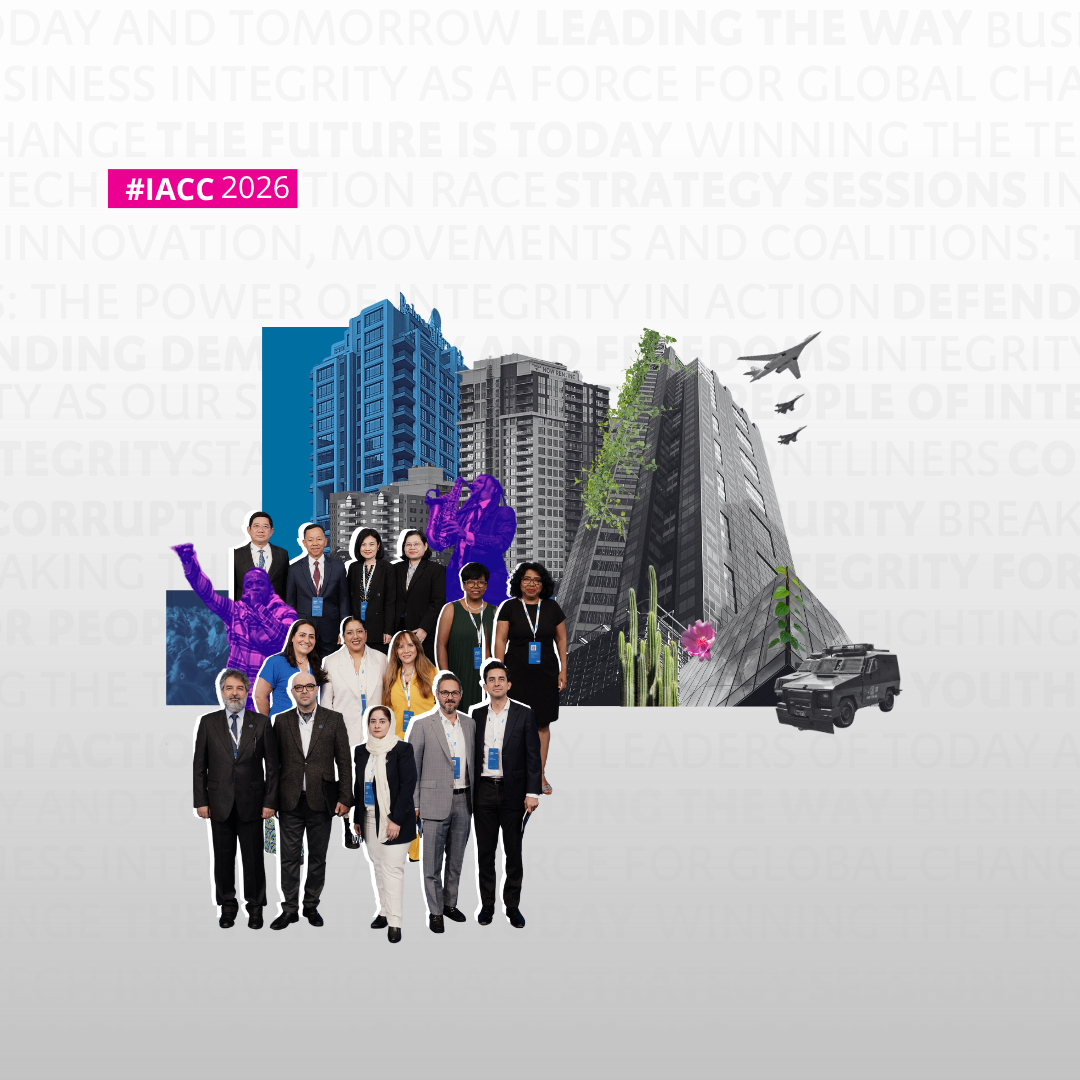
From Eastern Europe to the Sahel, from Central America to the Middle East, corruption is both the fuel and the profit of violence and war. Authoritarian leaders, kleptocrats and their allies continue to exploit the power enabled by dirty money.
This track will showcase solutions to break the links between dirty money, corruption, conflict, and human suffering. We aim to craft strategies to counter engineered fear and division, chaos and impunity. The objective will be to develop bold new strategies and partnerships to break the cycle of violence.
Welcome! Below you will find the list of workshop sessions currently planned for this thematic track at #IACC2026. Full session details and the complete conference agenda will be available soon. As the programme continues to be refined, sessions may be updated or adjusted. Stay tuned for updates.
Workshops
-
The Economics of Crime: Corruption, Organized Crime, and Money Laundering
Organized crime poses a growing cross-border threat to economic and financial stability, global security, and the rule of law—fueling corruption, weakening institutions and their governance, and generating vast illicit flows through sophisticated networks. Drawing on a forthcoming book — —The Economics of Crime in Latin America: From Diagnosis to Policy Responses (Palgrave Macmillan)— this panel examines macroeconomic impacts, enforcement gaps, and coordinated, economically informed solutions to disrupt these incentives.
International Monetary Fund (IMF)
International Monetary Fund (IMF), Global Initiative Against Transnational Organized Crime (GI-TOC) and Fundación Ciudadanía y Desarrollo (TI-Ecuador)
-
Anti-Corruption as Conflict Prevention: Lessons learned from Conflict-affected Settings
Anti-corruption tools and approaches can directly contribute to conflict prevention. Drawing on cross-sectoral research, guidance and practical insights will examine tools, lessons learnt and good practices from addressing corruption in fragile and conflict-affected settings and discuss the role of civil society in advancing integrity and transparency to contribute to peace and stability.
United Nations Office on Drugs and Crime (UNODC)
United Nations Office on Drugs and Crime (UNODC), Transparency International Defence & Security, Office of the Resident Coordinator (UN Kenya), UNDP Arab States, Anti-Corruption and Integrity and Transparency International - Colombia
-
PPPs Critical to Fight Organized Crime and Threat Networks Fueling Global Corruption and Insecurity
- Develop and Launch a formal IACC PPP on Fighting Organized Crime and Threat Networks fueling global corruption and insecurity.
- Announcing a series of future IACC training lead by ICAIE and other NGOs working with investigators and prosecutors.
- High key global trends and data from a criminal-threat convergence prism.
International Coalition Against Illicit Economies (ICAIE)
International Coalition Against Illicit Economies (ICAIE), Illicit Shadows, Senator Bill Cassidy Office, U.S. Department of Homeland Security and The Organized Crime and Corruption Reporting Project (OCCRP)
-
Igniting Integrity Against Criminal Capture: Data to Disrupt Corrupt Networks
The World Bank Group
Global Initiative against Transnational Organized Crime, Transcrime, Global Initiative Against Transnational Organized Crime (GI-TOC), Specialized Prosecutor’s Office for Combating Corruption (FEMCC), Mexico and University Of Birmingham
-
Shadow Alliances: Authoritarian Influence and Organized Crime in Latin America
Latin America faces rising economic strain and geopolitical rivalry as authoritarian powers expand through hybrid strategies merging statecraft and crime. Russia, China, and Iran use corruption, illicit finance, sanctions evasion, and transnational crime to pursue strategic aims. The event introduces “Shadow Fusion,” the link between organised crime and foreign influence, and shifts from reactive enforcement to system-level disruption: mapping crime–state ties, securing key infrastructure, and targeting offshore enablers. It shares findings from applying CSD’s State Capture Assessment Diagnostic (SCAD) & Kremlin Playbook methods in Latin America, exposing how elites and foreign actors exploit extractive rents, politicised rules, and state firms to entrench influence and weaken security.
Center for the Study of Democracy (CSD)
Center for the Study of Democracy (CSD), Bureau of International Narcotics and Law Enforcement Affairs, IBI Consultants, National Defense University's Center for Complex Operations andFlorida International University’s Jack D. Gordon Institute of Public Policy
-
From Reports to Results: Financial Intelligence Units at the Frontline against Dirty Money
How do we use suspicious transaction reports to combat corruption and IFFs? This session will spotlight the role of FIUs in disrupting corruption-linked illicit finance and address the bottlenecks that blunt their impact – from constraints on autonomy and data access to lack of resources. It will debate reform priorities and practical fixes to to help FIUs respond more effectively to dirty money.
Transparency International - Brasil
Transparency International - Brasil, Brazil's Financial Intelligence Unit (Conselho de Controle de Atividade Financeira), FIU Dominican Republic (Unidad de Análisis Financiero – UAF), Stolen Asset Recovery Initiative (StAR) – World Bank–UNODC
-
Who Watches the Gatekeepers? Raising the Bar on Supervision
How do we stop high-risk gatekeeper services from undermining anti-corruption efforts? Supervision remains the weak link – with self-policing, fragmentation and too few consequences when professionals enable dirty money. This panel takes stock of emerging consensus after the UK Illicit Finance Summit, presents fresh cross-country findings and maps the next steps for stronger global standards.
Transparency International
Transparency International, Financial Action Task Force and Commonwealth and Development Office (FCDO) and Financial Action Task Force
-
Closed Regimes, Dirty Deals: Leveraging Transnational Accountability Tools Against Kleptocracy
This workshop will center on three illicit supply chains: 1) gold 2) talc and 3) online scam centers known as “pig butchering”. It will focus on the innovative evidence collection approaches and transnational accountability mechanisms used by CSOs to disrupt the supply chains and put international pressure on the autocratic regimes.
National Democratic Institute (NDI)
National Democratic Institute (NDI), Lex Collective, Institute for Strategy and Policy - Myanmar, Transparencia Venezuela and Resilient Societies - Afghanistan
-
From Public Funds to Private Capital: How to Follow the Amazon’s Money Trail
Pulitzer Center
Pulitzer Center, Folha de São Paulo, O Joio e o Trigo and University of São Paulo
-
10 years after the Panama Papers: Defending Ownership Transparency and Following the Money Across Borders
Corruption rarely stops at national borders – and neither do stolen assets. Beneficial ownership transparency is central to tracing stolen assets, recovering the proceeds of corruption and tackling illicit finance. Yet, ten years after the Panama Papers exposed the opaque ownership structures facilitating global financial crime, progress remains uneven. While many countries have established beneficial ownership registers, access to and usability of this data varies considerably.
In this panel debate, speakers will reflect on fresh cross-country findings on the availability, quality, and use of ownership information across jurisdictions. Drawing on practical case studies, they will examine how robust beneficial ownership data supports a wide range of public-interest objectives, including corporate due diligence and market integrity, effective public procurement, and anti-money laundering enforcement. Particular attention will be given to the role of public-interest actors – including investigative journalists, civil society organisations and researchers. Speakers will reflect on emerging good practices, opportunities for cross-border corruption, and the policy priorities required to ensure ownership transparency delivers on its promise as a tool for combatting corruption and illicit finance.
Transparency International
-
Naming the Unnamed: Defining, Documenting, and Measuring Sexual Corruption to Reduce Impunity
What do we know about sexual corruption, its prevalence, its drivers, and the victims and perpetrators involved? Surprisingly little. Sexual corruption is one of the most under-documented forms of corruption worldwide, and until recently it did not even have a name of its own. That absence of language has been part of the problem: without a shared definition, the phenomenon gets folded into broader corruption or gender-based violence frameworks, and the specific dynamic at its core, the trading of power for sexual access, gets lost. Debates around terms like sexual corruption versus sextortion are not just semantic. They shape whether the focus stays on the abuse of power itself.
Definitional gaps feed directly into data gaps. The absence of sexual corruption from official statistics is too often mistaken for the absence of the phenomenon, when in fact it reflects stigma, fear, and the structural barriers that keep victims from reporting. Without data, there is no evidence base. Without evidence, there is no policy
Transparency International Secretariat (TI-S)
Transparency International, UU RESC (Uppsala University Research Environment on Sexual Corruption), Fundación Poder Ciudadano (TI Argentina), Data Against Feminicide, Independent Commission for Human Rights in Ramallah (Palestine), Fletcher School, Tufts University and Besa Global
-
Building effective pathways to redress for victim-survivors of sexual corruption
This workshop looks at the development and implementation of responses and redress pathways for victim-survivors of sexual corruption. It links research, civil society advocacy, and institutional transformation to showcase concrete responses to sexual corruption and explore how shifts in social norms and institutional practices can advance victim-survivor-centred redress. Its objective is to identify effective models of victim-survivor protection and redress for future network building and collaborative advocacy.
Transparency International Secretariat (TI-S)
SIDA (Swedish Development Agency), UNODC, U4 Anti-Corruption Resource Centre, International Federation of Women Lawyers (FIDA), Verité Research and Brazilian Parliament
-
Glue, Grit and Guiding Integrity: Institutionalising Anti-Corruption Efforts in Reconstruction.
Reconstruction is about rebuilding trust as much as infrastructure – under urgency, political pressure, and high financial stakes. It is a pivotal phase shaping institutional incentives, accountability structures, and long-term governance. This session explores how to institutionalise context-sensitive integrity efforts from the start to make reconstruction more corruption resistant.
Federal Ministry for Economic Cooperation and Development (BMZ)
GIZ, BMZ DANIDA, UNODC and Transparency International Lebanon
-
Citizen Oversight and Reforms to strengthen Judicial Integrity
An interactive fishbowl discussion on the role of citizen oversight in judicial appointments and its importance for judicial independence, integrity, and public trust. Participants will also debate two key anti-corruption reforms: making corruption offenses imprescriptible and allowing flexible maximum trial durations for complex corruption cases, while safeguarding due process.
Red de Observadores por la Institucionalidad (ROI)
Participación Ciudadana (PC), Red de Observadores por la Institucionalidad (ROI) and Fundación para el Debido Proceso (DPLF)