View #IACC 2026 Thematic tracks
Integrity for People and Planet Regeneration: Fighting the Theft of Our Future
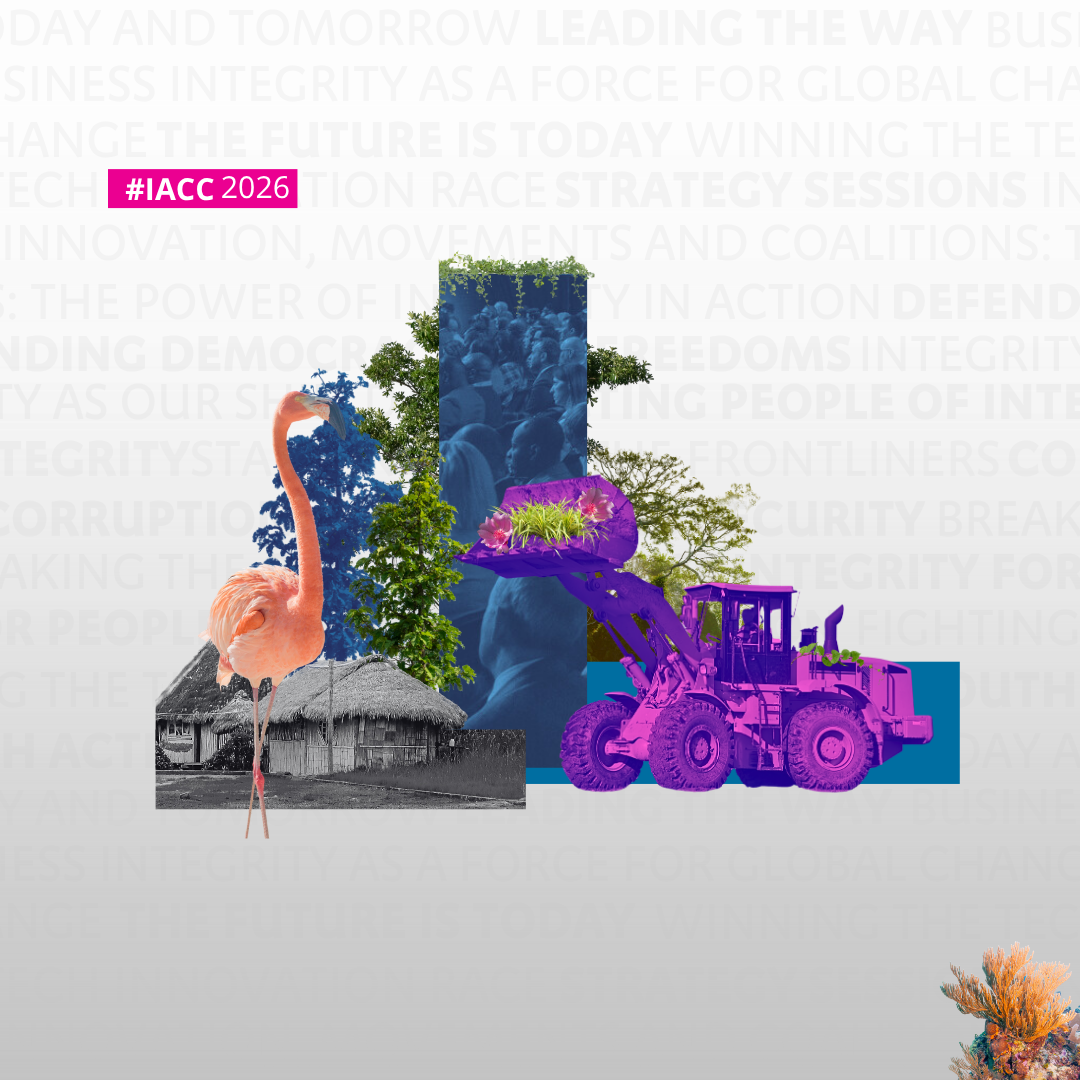
Climate collapse and environmental destruction are not only the result of emissions and exploitation, but also of corruption and the unsatiable greed for money. From rigged contracts in climate finance and a free card to polluting companies, to criminal exploitation of forests, oceans, and indigenous lands, corruption is accelerating the planetary crisis.
This track will expose how and where corruption allows the devastation of the environment and will define strategies that connect social and environmental justice with anti-corruption efforts, ensuring that integrity becomes the driver of environmental protection and sustainability.
Welcome! Below you will find the list of workshop sessions currently planned for this thematic track at #IACC2026. Full session details and the complete conference agenda will be available soon. As the programme continues to be refined, sessions may be updated or adjusted. Stay tuned for updates.
Workshops
-
How Mining and Organized Crime are Transforming the Amazon's Social, Political, and Environmental Landscape?
Illegal mining and organized crime are reshaping the Amazon in ways that extend far beyond environmental destruction. Their growing convergence undermines governance, fuels corruption, and profoundly affects the daily lives of local communities. This panel will examine how illegal mining and organized crime have become intertwined, transforming the Amazon’s social, political, and environmental landscape. It will also discuss law enforcement and people’s resistance in the Amazon
Pulitzer Center
Pulitzer Center, Amazon underworld, Forum Brasileiro de Seguranca Publica and Universidade Federal de Roraima and Federal Prosecution Service (MPF), Brazil
-
Profiting from Destruction: Data Tools Exposing Environmental Crime and Public Contracts
IACC COLPIN SESSION
Across Latin America and beyond, companies fined for deforestation and illegal mining continue winning government contracts. This workshop unites four civil society tools to break that cycle: CruzaGrafos maps corporate networks behind offenders, Sociedad.info tracks procurement across 54 countries, TI Brazil reveals how governments hide critical data, and DOZORRO shows how AI can flag risky tender
Abraji (Brazilian Association of Investigative Journalism)
Abraji (Brazilian Association of Investigative Journalism), Transparency International - Brazil, Abrimos.info, Sociedad.info and Transparency International Ukraine
-
Africa Mining Watch: Powering Investigative Journalism with AI
IACC COLPIN SESSION
A partnership between journalists and civic tech developers is driving a unique initiative to shed light on the energy transition and the mining of strategic minerals. Launched in July 2026, the Africa Mining Watch platform uses artificial intelligence to map open-pit mines across the continent’s tropical belt. In this session, we’ll show how this technology is being adopted by investigative journalists and how it can be adapted by other stakeholders, such as NGOs and governments. Also, we will show how the technology was adapted from previous experiences in Latin America and how it can be used in other geographies
Pulitzer Center
Pulitzer Center, Rainforest and InfoNile and Investigative journalist specializing in environmental issues and wildlife crime
-
Promoting Integrity for People and Planet One Sector at a Time
Jointly organized by UNDP and the World Bank, the workshop’s overall aim is to present data and expertise, and enable discussion, on the added value of sector-specific integrity strategies that mix investigative and preventive approaches and match them with the incentive structures and opportunities to commit corruption that exist in the environment and energy sectors.
UNDP Arab States
World Bank, UNDP, Federal Commission of Integrity (Iraq) and Independent Expert, Energy Governance
-
Nature, Money, Conflict: How to Disrupt the Financial Drivers of Environmental Crime and Insecurity
We explore how corruption-enabled environmental crime and illicit finance erodes governance and stability. We unpack why environmental crime & corruption remain deprioritised and examine the financial system’s role in both enabling harm and driving solutions; we highlight partnerships and innovations that are elevating the prioritisation of environmental crime and corruption.
WWF International
WWF International, Global Initiative Against Transnational Organized Crime (GI-TOC), Basel Institute on Governance and FACT Coalition
-
Corruption in the Shadows; Environmental Crime in Plain Sight
One of the less understood aspects of corruption is its effect on the environment and people whose lives rely upon the promise of the earth. Whether corporate, government or mercenaries wreaking havoc, the environment is the ultimate victim of corruption, occurring in every corner of the world. This workshop illustrates the effects through case studies and introduce tools and solutions.
The Sentry
The Sentry, UNODC, Environmental Investigation Agency (EIA) and Latin America Bureau, Mongabay
-
Real-World Integrity Solutions for SIDS: Experiences from climate and disaster operations
Practical tools to curb corruption in climate finance and disaster response in SIDS. Case studies will be provided to explore the different approaches used in different jurisdictions and lessons learnt from them to frame stronger safeguards in these climate and disaster operational locations. These will also be discussed in light of International laws and regulations that have set the standards of good practices and expectations which should be implemented domestically in SIDS.
Wildlife Justice Commission
UNODC, GOPAC, Palau Island Times, Pacific Anti-Corruption Journalists Network, CARICOM Youth Ambassador (Trinidad & Tobago), Transparency International Secretariar and High Court of Solomon Islands
-
Building Trusted Carbon Markets – Views from Anti-Corruption Leaders, Standard Setter, and Accreditation Body
As carbon markets become central to meeting 2030 climate and Paris Agreement goals, their success hinges on market participants acting with ethics and integrity. Practical tools for transparency and accountability that are critical to their success will be discussed. Panelists include experts from a standard-setter, anti‑corruption organizations, and an accreditation body.
Verra
Basel Institute on Governance, Transparency International, Transparency International Indonesia, Verra and American National Standards Institute (ANSI)
-
Security Guarantees, Resource Contracts, and Corruption
As part of its transactional foreign policy, the Trump Administration is requiring states to provide access to natural resources to the US government and/or elites linked to the Trump Administration. This panel will highlight the corruption concerns of four case studies of the nexus of security guarantees and natural resource contracts plus policy recommendations for business and civil society.
Georgetown University
Georgetown. University, Transparency International-US, Velta Holding US, Inc, The Sentry, Human Rights Foundation
-
Toxic Profits: Corruption and Environmental Crime in Southeast Asia
Corruption fuels environmental crime across Southeast Asia—from waste trafficking to harmful infrastructure projects. This session explores how stronger transparency, investigative journalism and accountability can disrupt these networks and protect people, natural resources and the environment.
The Center to Combat Corruption Cronyism
Southeast Asian Anti-Corruption Network of CSOs (SEA-CAN), Rappler, Journalists Against Corruption (JAC), TEMPO Indonesia, Human Rights, Democracy & Rule of Law, Embassy of Sweden, Bangkok
-
Climate Governance Under the Spotlight: Integrity Lessons from COP31
Ahead of COP31 in Turkiye, this workshop will examine corruption risks in climate governance, from green finance and carbon markets to public procurement and host-country accountability. Using COP31 as a case study, participants will identify integrity gaps and develop safeguards to strengthen transparency, accountability, and trust in global climate action.
Transparency International Turkiye
Transparency International Turkiye, Transparency International Australia and Transparency International Secretariat
-
Exposing and Removing the Barriers to Protecting our Oceans
Ocean governance is fragmented, opaque, and susceptible to corruption. In this workshop, we discuss specific governance issues that enable slave labor, illegal fishing, and trafficking such as flags of convenience, regulatory gaps, and conflict of interest. Together with the audience, we try to think of solutions and consider the role of the High Seas BBNJ treaty, which came into force this year.
Pulitzer Center
Pulitzer Center, Revista Anfibia, The Globe & Mail and freelance Journalist